
Go to chatgpt.com, make an account, and you are in on the free plan. Everything below is what to do in the next ten minutes, starting with the one setting most people never open.
The five things to do first
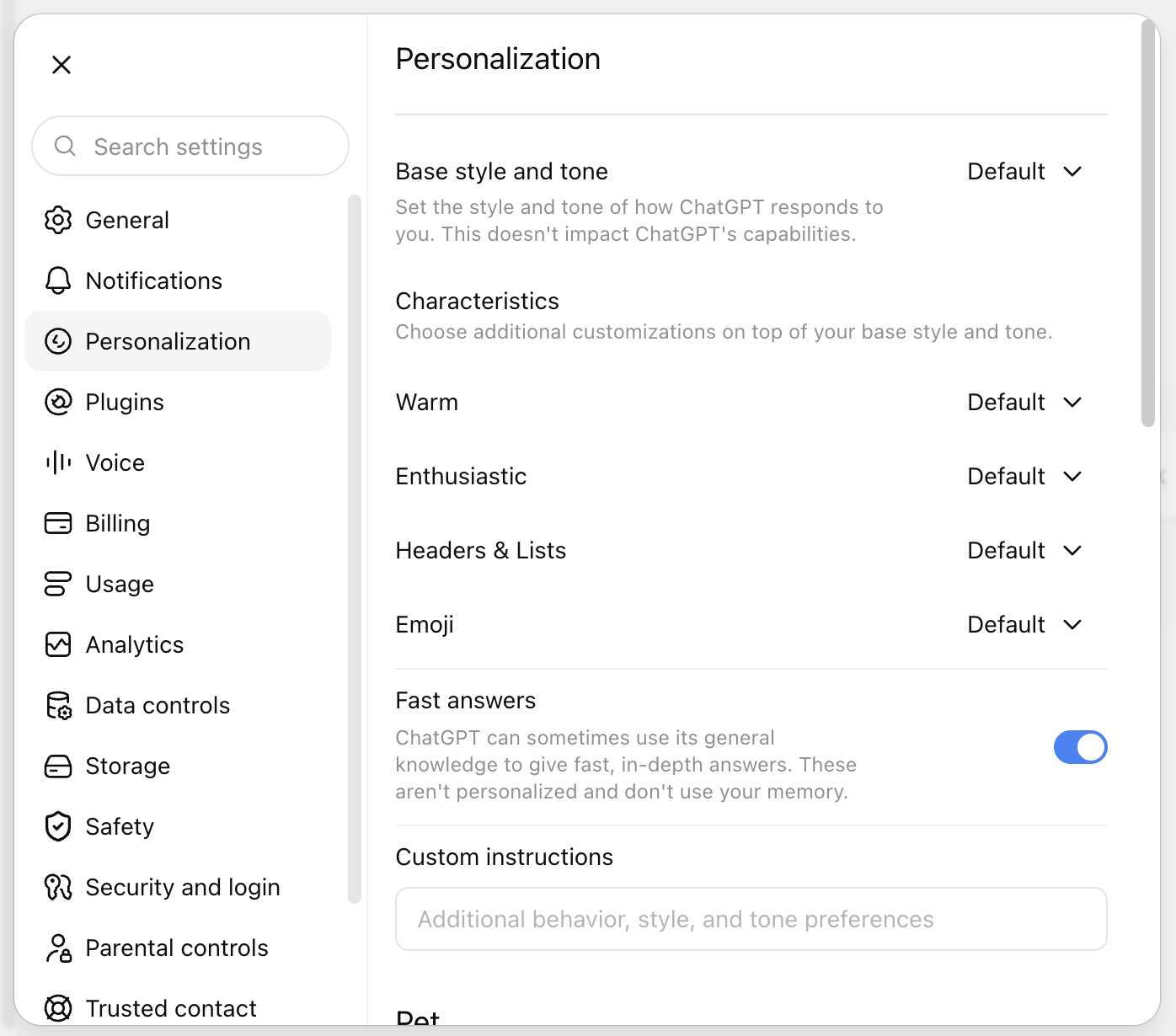
- Fill in your custom instructions before you ask it anything. Open your personalisation settings directly at chatgpt.com/#settings/Personalization, or if the link ever moves, search settings for "instructions". This is the only setup that applies to every future chat, which makes it the highest-value ten minutes you will spend in the tool.
- Ask for the actual output you want, and describe it. Do not ask about a topic, ask for the finished thing and say what it should look like: the format, the length, and the tone. "Write the three-line message I send to cancel this gym membership, polite, no explanation" beats "help me cancel my gym". The description is the whole point, because it is what stops ChatGPT handing you a general briefing you then have to rewrite.
- Know what the model picker is choosing. The dropdown at the top swaps between models that differ in speed, cost and how hard they think. On a paid plan the list can change as new models roll out, so what you see one week may look different the next. Pick the fastest one for quick jobs, because thinking time is wasted on a two-line email.
- Check what it remembers about you. ChatGPT carries things between chats through its memory, which is useful and also means it quietly keeps details you may not have meant to leave. Open the memory settings once, read what is in there, and delete anything you would not want turning up in an answer next month.
- Push back in the same chat instead of starting over. "Too formal, halve it, and cut the last paragraph" gets you there in one turn. Starting a new chat throws away everything it just learned about what you wanted, so the second attempt starts from zero all over again.
The Custom Instructions block
Two boxes, filled once, applied to every chat afterwards. Paste the first half into the box asking what it should know about you, and the second half into the box asking how it should respond. Change the brackets to your real life.
WHAT IT SHOULD KNOW ABOUT ME

I am [YOUR JOB OR SITUATION IN ONE LINE. For example: a freelance designer working with small business clients. Or: a parent of two going back to work after five years out.]

Most of what I bring you is [THE KIND OF WORK. For example: client emails, quotes and proposals, planning my week, working out what official letters mean, captions for Instagram.]

The people who read my writing are [WHO. For example: clients who are not designers, my kid's school, customers, my manager.]

Things that are always true for me: [ANYTHING THAT SAVES YOU REPEATING IT. For example: I am in the UK so use British spelling and pounds. I write short. I never use emoji.]

HOW IT SHOULD RESPOND

1. Answer first, reasoning after, and only if I need it. No warm-up sentence, no restating my question back to me.
2. Use plain words. If I would not say it out loud to a person, do not write it. No "delve", "elevate", "unlock", "in today's world", "it's not just X, it's Y".
3. Match the length I asked for. If I did not say, keep it short and offer to go longer.
4. Never invent a fact, a number, a date, a price, a name, or a source. If you do not know it or I have not told you, write "not given" and leave it for me. Do not fill the gap to make it read better.
5. When I could genuinely go two ways, ask me one question. Otherwise choose, and tell me in one line what you assumed.
6. On anything I might send or publish, finish with one short line naming the part you are least sure about.
An example of a good ask
Setup done. Here is the shape of a strong everyday prompt: the context, the actual task, the format you want, and one limit. Copy it, swap in your own, and you will feel the difference straight away.
Context: I run a small bakery and I am writing to a supplier I use every week.

Task: Write a short email asking them to move our Friday delivery to Thursday from next week, and to confirm the new time back to me.

Format: Four sentences or fewer, friendly but direct, ready to send as is.

One rule: Do not invent an order number, a name, or a price. If you need one, leave a clear gap for me to fill.
Where the line is
- One catch: memory means it is never quite a blank page. An answer that surprises you is often the tool using something you told it in a chat weeks ago, which is great until it is a detail about a client or your health turning up somewhere you did not expect.
- Read your memory settings once a month. Clear what does not need to be there.
Set it up before your next question
Open settings, paste both halves of the block in, and then ask it the thing you were going to ask it anyway. Ten minutes once, and every chat from now on starts knowing who it is talking to.
If you want the same setup for Claude, read Your first hour with Claude. If you are weighing up which one to pay for, read Which AI subscription is actually worth it.